7 Elements of a Winning Cosmetic Product Brief: Don’t Start Manufacturing Without This
Have you ever tried to explain a haircut to a stylist, only to walk out looking completely different than you imagined? Now, imagine that mistake costing you thousands of dollars and months of time. That is exactly what happens when new beauty founders try to communicate with manufacturers without a Cosmetic Product Brief.
Launching a K-Beauty brand in the US is a dream for many, but the gap between your vision and the manufacturer’s execution can be a nightmare. In this post, we will dive into the “Blueprint” of your business—the Cosmetic Product Brief—and the first two critical steps to getting it right: The Story and The Benchmarks.
Table of Contents
Why Your “Good Idea” Isn’t Enough for Manufacturers
Many entrepreneurs make the fatal mistake of contacting a Korean OEM/ODM manufacturer with a vague request: “Please make me a good moisturizing cream.”
To a formulator, this is equivalent to telling an architect, “Build me a cool house.” The “cool house” in your mind might be a modern glass villa, while the architect is drafting a cozy log cabin. Both are “cool,” but they are worlds apart.
The Role of the Cosmetic Product Brief
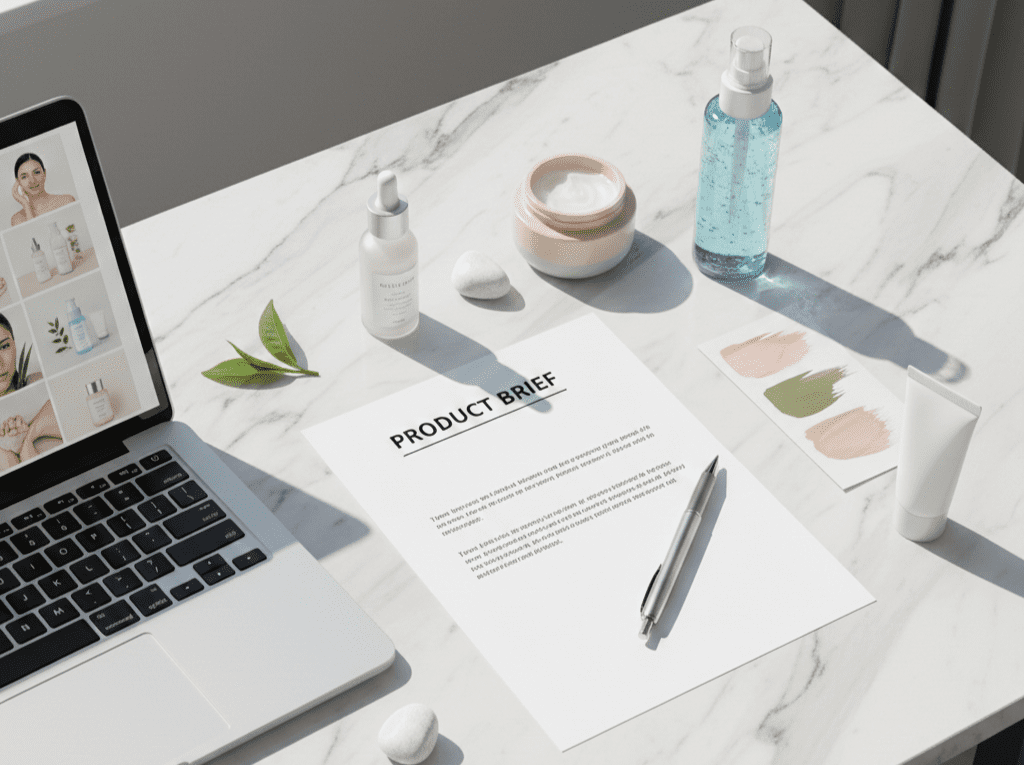
A Cosmetic Product Brief (or Cosmetic Product Concept Document) is your design blueprint. It details every aspect of your new product, serving two main purposes:
- A Compass for You: It keeps your brand philosophy on track during the chaotic development phase.
- A Guideline for the Lab: It ensures the manufacturer accurately translates your abstract vision into chemical reality.
A well-crafted brief separates the amateurs from the pros. It signals to Korean manufacturers that you are prepared, serious, and easy to work with.
Element 1: The Product Story (The ‘Why’)
Before you talk about ingredients or textures, you must define the soul of the product. This isn’t just marketing fluff; it tells the chemist who they are making this for.
- The Concept: Define it in one sentence. Is it a “Simple yet healthy night ritual”?
- The Connection: How does this fit your brand? For example, if your brand is for busy moms, your story might be: “To offer Chloe, who is too busy for a 10-step routine, a single-step night ritual that delivers healthy, well-slept skin.”
- The Pain Point: Whose problem are you solving? If you don’t know the pain point, you don’t have a product; you just have a commodity.
[Internal Link: Read more about defining your Target Audience in our previous post]
Element 2: The Power of Benchmarking
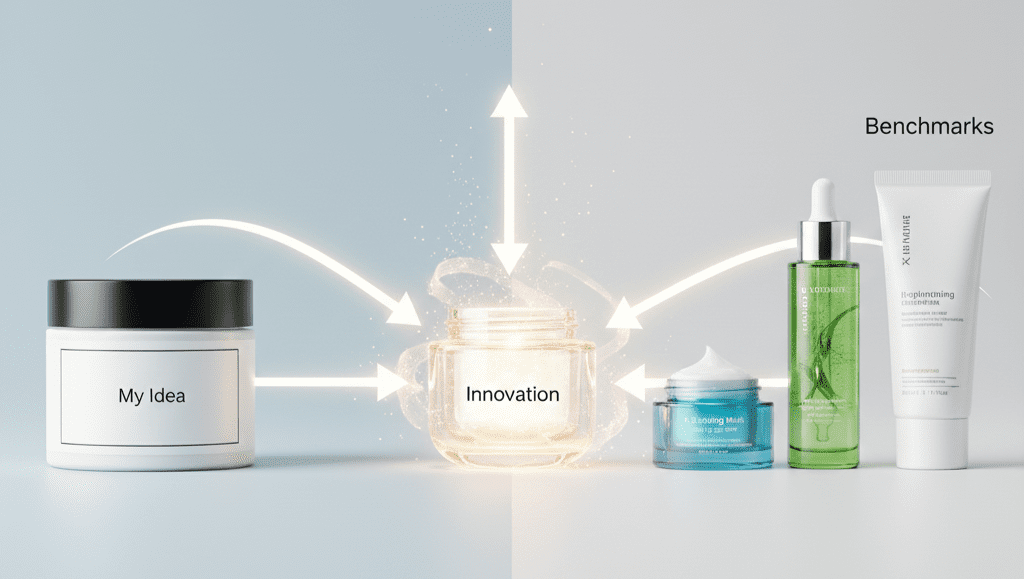
Here is a pro tip that is worth its weight in gold: Manufacturers speak the language of “References.”
The most effective way to communicate sensory details (smell, touch, feel) is through existing products. You cannot simply describe a texture as “sticky but not too sticky” via email. You need physical benchmarks.
How to Choose Your Benchmarks
Select 2–3 products that are currently on the market. They don’t have to be perfect, but they should serve as reference points.
- Benchmark A (Texture): “I want the exact thickness of the Laneige Water Sleeping Mask.“
- Benchmark B (Finish): “However, I want it to absorb faster, like Torriden’s Dive In Serum.”
- Benchmark C (Scent): “Use a subtle, natural scent similar to Huxley’s Secret of Sahara.”
Analyzing for Success
When creating your brief, buy these products. Test them. Analyze specifically what you like and what you want to improve.
- Like: Texture, absorption speed, container shape.
- Dislike: Scent is too strong, price is too high, finish is too oily.
By combining the best traits of top-selling products (like those found on Amazon’s Best Sellers list), you are essentially creating a “Super Product” that addresses the market’s current complaints.
Why This Matters for Your Wallet
The first email I ever sent to a manufacturer was vague. Predictably, the sample I received three weeks later was unusable. I wasted three months going back and forth to fix it.
If I had provided a brief with clear benchmarks, I could have saved two months of development time. In the fast-paced beauty industry, time is money.
In our next post, we will dive deep into the ingredients—choosing the “Hero” that sells the story and the “Sidekicks” that do the work.
Ready to start drafting? Don’t just dream about it. Go to Amazon or Sephora today, buy 3 products that are similar to your idea, and start taking notes. That is your first step from “Dreamer” to “Founder.”