The $0 Success Trap: Why Your “Best Product” Will Fail Without Fit
Achieving product market brand fit is the single most critical factor determining a beauty startup’s success. You spent months, maybe even years, creating the perfect product. A beautiful formula, luxurious packaging, even a great name. You finally launch, but the result is devastating. Nobody buys it.
What went wrong? The cause almost always comes down to a lack of Fit.
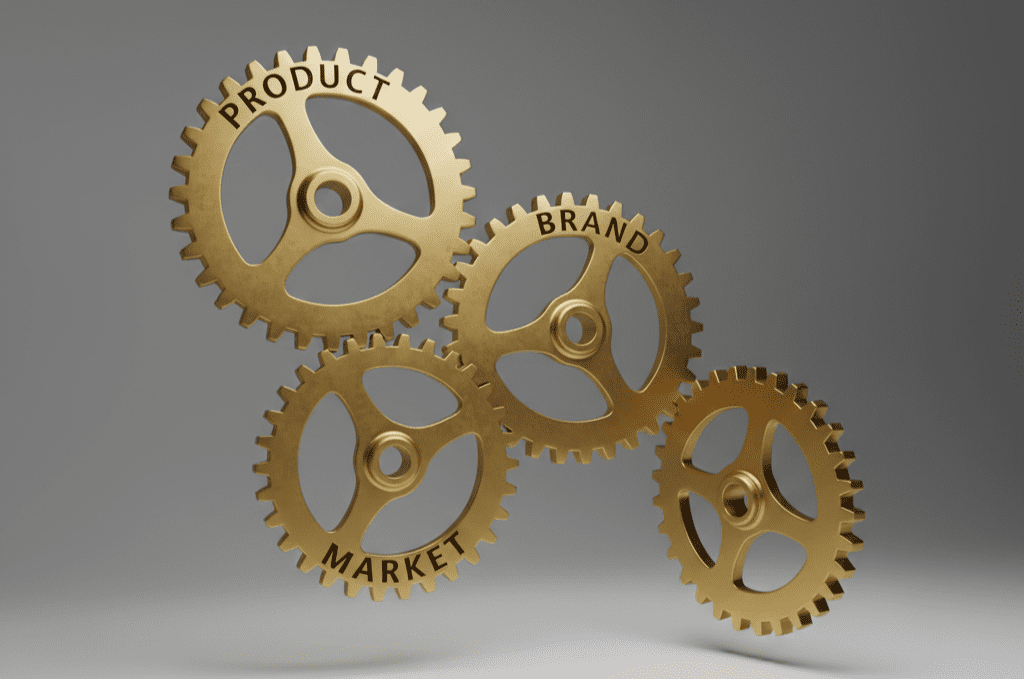
Many founders make the mistake of focusing only on making the “best product.” But a successful brand isn’t built on a great product alone. It’s like three gears turning in perfect sync: Product, Market, and Brand. When these three elements align perfectly toward a single goal, we call it achieving “Product-Market-Brand Fit.”
In this post, we will deeply analyze the Product vertex and understand why simply having a “good cream” is a recipe for failure.
Table of Contents
The Most Common Reason for Failure: The “Best Product” Trap
The reason countless well-funded beauty startups fail is often a narrow vision. They believe Product excellence is the only metric for success. They focus $100,000 on R&D but $0 on finding the correct market voice.
A successful product requires all three gears—Product, Market, and Brand—to rotate flawlessly together. If even one gear slips, the entire mechanism grinds to a halt. This perfect alignment is the essence of product market brand fit.
Redefining “Product”: Beyond the Formula
In today’s hyper-competitive beauty industry, a “product” is not just the contents inside a container. It is the sum of everything the customer experiences, from the first time they see your ad to the moment they use the last drop.
Understanding this holistic definition is the first step toward achieving product market brand fit.
The Three Levels of Product Experience
To achieve product market brand fit, you must design value at every level of the customer journey:
Core Product
The fundamental ‘benefit’ or ‘problem-solving’ your product provides. Example: Relief from redness. If your core product fails, no amount of marketing can save it.
Actual Product
The physical elements surrounding the core benefit. This includes the formula, texture, scent, package design, and brand name. This is where your R&D and design efforts are realized.
Augmented Product
The ‘additional value’ provided beyond the actual product. In a competitive market like today’s, this augmented product becomes the differentiating factor that drives a purchase.
- (e.g., friendly customer service, an emotional unboxing experience, useful ‘how-to’ content, or subscription personalization).
The Augmented Product in K-Beauty (Expansion)
In the K-Beauty landscape, the Augmented Product is not optional—it is mandatory. Consumers are overwhelmed by choice. Your augmented offering must overcome consumer fatigue.
- Emotional Unboxing: K-Beauty brands often use intricate, multilayered packaging to make the customer feel like they are unwrapping a gift, not a commodity. This elevates the actual product.
- Content Experience: Providing detailed, expert ‘how-to’ guides or engaging tutorials (beyond simple instructions) turns the product into a solution system.
- Community: Creating a feedback loop or a social forum around product use fosters loyalty, transforming a transactional purchase into a relational experience.
Brand Spotlight: Tamburins and the Augmented Product
The Tamburins brand perfectly demonstrates the power of the Augmented Product in achieving product market brand fit.
Tamburins elevated its hand cream beyond the core product of a ‘moisturizer’ into the realm of an augmented product: a ‘fashion accessory’ and an ‘art object.’ The unique chain decoration, the sensual fragrance, and the gallery-like showrooms are all part of the ‘product’ experience. They aren’t just selling hand cream; they are selling a ‘sensory and artistic lifestyle.’
Action Item: What ‘augmented experience’ can your product offer that transcends mere functional moisturization?
Up next: We move to the second critical gear: Discovering Your Market by defining your single Ideal Customer Avatar (ICA).