Launch Blueprint: 3 Proven Strategies to Start Your Beauty Brand
The lean launch strategy is defined by one core principle: prioritizing speed and cost-saving over everything else. Now that you know the true $17k to $61k cost to launch a beauty brand, you must choose your game plan.
Your initial budget doesn’t just fund your brand; it defines your strategy. There is no single right answer. The optimal path depends on your capital, your risk tolerance, and your brand’s vision.
This post breaks down the three primary strategic paths for entering the US market.
Table of Contents
The Three Strategic Game Plans
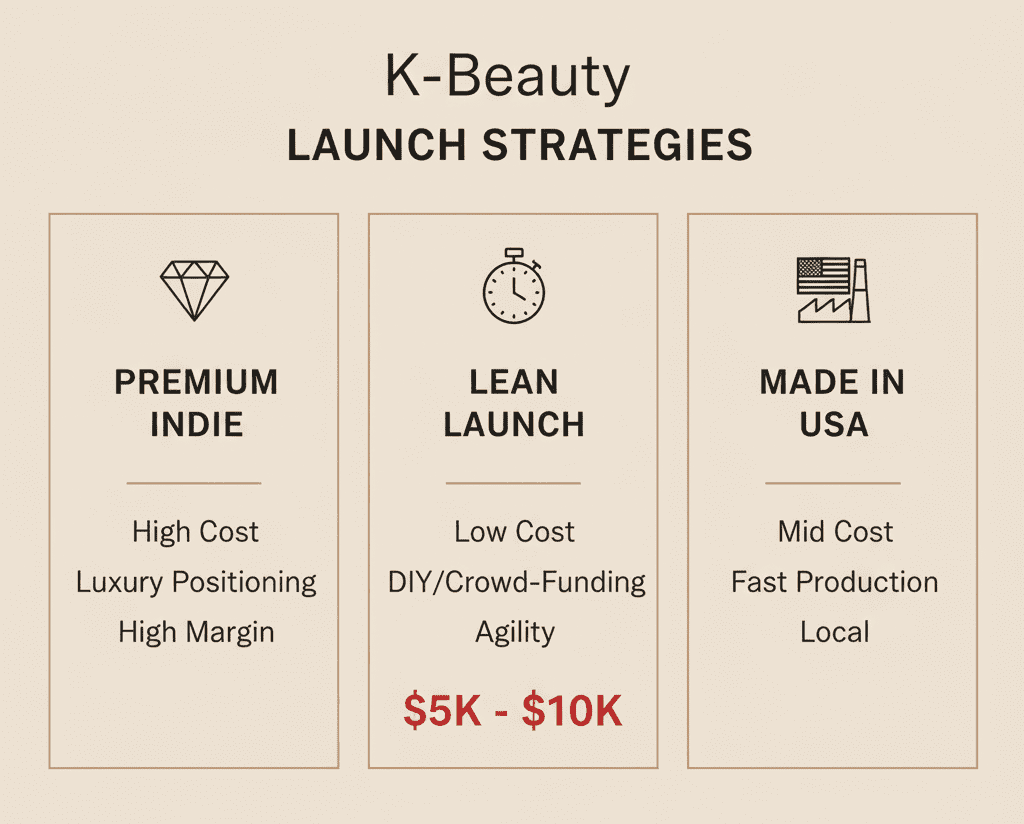
Before reviewing the budget, understand the core trade-off of each:
- The Premium Indie Path: Stable path. Secures high margin (7x-10x) to invest in R&D and brand value.
- The Lean Launch Path: Agile path. Cuts initial costs to the extreme (under $15k) to minimize risk.
- Made in USA: Strategic path. Eliminates international shipping/tariffs to reduce Landed Cost.
Full Comparison: Premium vs. Lean vs. USA
This comparison table shows the realistic initial capital required for two of the paths, assuming the same 3,000-unit MOQ. Note how crucial the cost-saving strategies are for the lean launch strategy.
| Category | 1. The Premium Indie | 2. The Lean Launch | Lean Launch Cost-Saving Strategy |
| I. Product Costs (COGS) | |||
| First Production (MOQ 3,000) | $6,000 – $15,000 | $6,000 – $15,000 | – |
| Packaging | $3,000 – $10,000 | $1,500 – $2,500 | – Use stock containers, not custom. – Skip the unit carton (paper box) initially. |
| II. Operating Expenses (OpEx) | |||
| Website (DTC Store) | $500 – $3,000 | $100 – $300 | – Basic Shopify template, no agency. |
| Branding & Design | $1,000 – $5,000 | $50 – $200 | – DIY on Canva/Figma, don’t hire a designer. |
| III. Marketing Costs | |||
| Content Creation | $500 – $2,500 | $0 – $200 | – Shoot/edit on an iPhone, not in a studio. |
| Initial Ads & Seeding | $1,000 – $5,000 | $0 | – 100% organic marketing, no paid ads. |
| Total Estimated Initial Capital | $17,825 – $61,625 | $12,522 – $35,305 |
Deep Dive: The Lean Launch Strategy
The lean launch strategy is designed for founders bootstrapping with less than $15,000. It requires ruthlessly postponing non-essential costs.
Core Cost-Saving Tactics:
- Postpone Custom Packaging: Custom packaging is the biggest cost sink. Use readily available stock containers and skip the secondary unit box.
- DIY Design: Do not hire an agency. Use tools like Canva or Figma for your logo and basic website design.
- 100% Organic Marketing: Dedicate yourself entirely to building community and pre-launch buzz (like we discussed in Unlock Your Brand’s Soul: The 3-Step Secret to a Captivating Founder Story) with zero paid ads.
If you need to launch using the lean launch strategy for under $10,000, you must use crowdfunding or pre-orders (which we’ll cover in the future) to postpone the initial production (MOQ) and international shipping costs.
The Strategic Alternative: Made in USA
International shipping and tariffs are the main culprits that inflate Landed Cost. The ‘Made in USA’ alternative solves this.
| Category | Pros | Cons |
| Cost | ✅ ‘0’ International Shipping & Tariffs ✅ Lower Landed Cost | ❌ Per-unit production cost (COGS) might be slightly higher due to US labor. |
| Time | ✅ Fast production & fulfillment (4-8 wks) ✅ Flexible response to urgent orders | ❌ Initial setup & communication with US manufacturers takes time. |
| Branding | ✅ Appeal to customers who prefer ‘Made in USA’ | ❌ Loss of the ‘Made in Korea’ premium ❌ Direct competition with US brands |
J’s Note: If your brand concept is closer to values like ‘Clean & Vegan’ rather than relying on traditional ‘K-Beauty’ ingredients, then ‘Made in USA’ is a very attractive option. Saving on logistics and getting fast fulfillment is a huge weapon for an early-stage brand. However, there might be limits to perfectly replicating the vast formulation library or the latest K-Beauty trends that Korean manufacturers offer. You must conduct thorough testing with the manufacturer to ensure they can deliver the quality you want.
Ultimately, your strategy is a declaration of what game you will play.
In the next post, we will analyze the “Amazon Trap”—the reason why you must never compete on price with low-cost K-Beauty, and how you can win by competing on value.