The Shocking Cost Unveiled: Use This Secret 7x Profit Formula
Up to this point, we have built a solid philosophy for why we must do this business and who it is for. Now, it’s time to answer the most practical question of all: “With what budget and what strategy will we enter the market?”
If you’re asking, “So, how much does it really cost to launch a beauty brand?” you’re asking the right question. There is no single correct answer, but understanding the realistic budget range is crucial. The global beauty market, valued at over $677 billion (Source: Statista – Global Beauty Market Report), continues to grow, ensuring opportunity for those prepared for the financial reality.
This post will give you a detailed financial template for launching a single product in the US market via DTC (Direct-to-Consumer).
Table of Contents
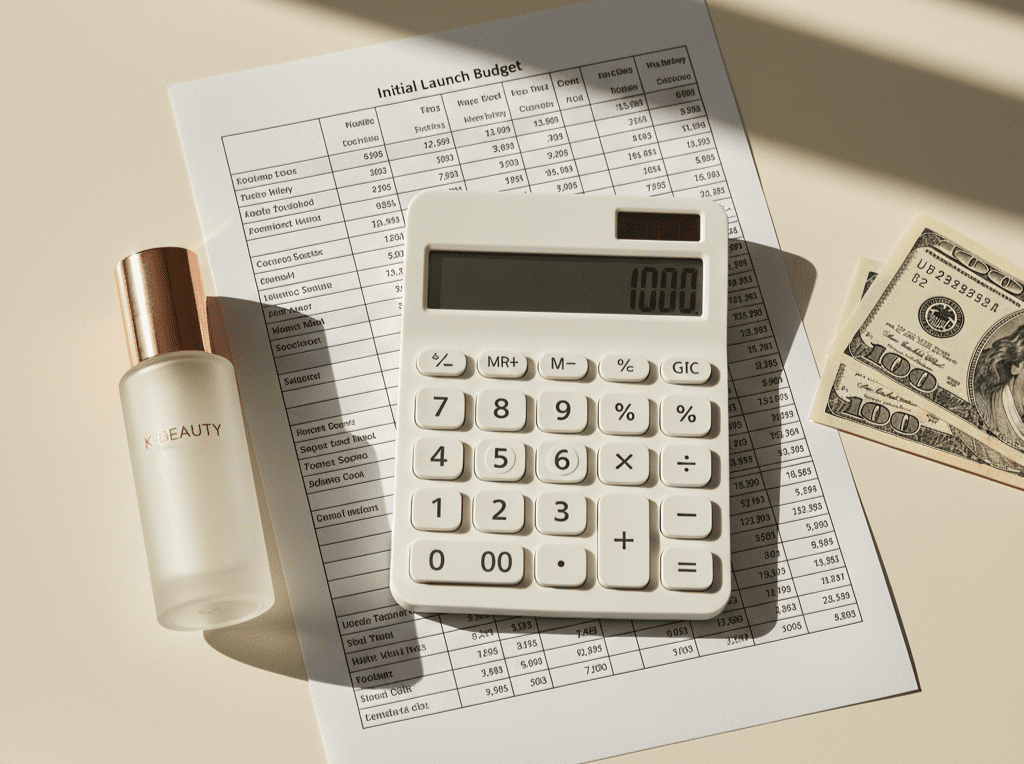
The Real Cost: $17,825 to $61,625
Below is a detailed budget analysis based on the industry standard MOQ (Minimum Order Quantity) of 3,000 units. This is the realistic cost to launch a beauty brand and get your first product on a shelf.
| Category | Description | Low End | High End | Notes |
| I. Product Costs (COGS) | ||||
| R&D & Formulation | Sample testing, stability testing, etc. | $500 | $3,000 | Can be charged separately by the manufacturer. |
| First Production (MOQ 3,000) | Based on 3,000 units ($1.50 – $5.00/unit) | $4,500 | $15,000 | |
| Packaging | Container, pump, printing, unit carton, etc. | $3,000 | $10,000 | Varies widely based on quantity and finishing. |
| II. Operating Expenses (OpEx) | ||||
| Business Formation & Trademark | LLC formation, trademark filing fees, attorney/service fees | $500 | $2,500 | Costs vary by state. |
| Website (DTC Store) | Shopify plan, theme, essential apps, etc. | $500 | $3,000 | DIY vs. hiring a freelancer. |
| Branding & Design | Logo, package design | $1,000 | $5,000 | DIY vs. hiring an agency. |
| III. Marketing Costs | ||||
| Content Creation | Product photos, video shoots | $500 | $2,500 | DIY vs. hiring an agency. |
| Initial Ads & Seeding | Influencers, social media ads | $1,000 | $5,000 | |
| IV. Other | ||||
| International Shipping | Korea -> US 3PL Warehouse | $1,500 | $4,000 | Air (expensive/fast) vs. Sea (cheap/slow) |
| Logistics & Warehousing | 3PL initial setup and storage fees | $1,000 | $3,000 | |
| Contingency Fund (15-20%) | For unexpected costs | $2,325 | $8,625 | Essential |
| Total Estimated Initial Capital | $17,825 | $61,625 |
Crucial Warning: Don’t Forget the Contingency Fund
The most important item in the table above is the “Contingency Fund.” Unexpected events—like packaging print errors, sudden shipping rate hikes, or customs problems—will 100% happen.
Budgeting without a contingency fund is like walking a tightrope without a safety net. This is part of the cost to launch a beauty brand that many founders overlook, and it often leads to catastrophic failure (a mistake I know well, as detailed in my $250k failure story). Make sure your contingency budget is at least 15% of your total projected costs.
Step 1: Calculate Your Landed Cost (The Real COGS)
Many founders make the mistake of thinking their product cost is just the factory price. It’s not. Your marketing budget should be based on a sustainable model, starting with your Landed Cost. Understanding this Landed Cost is essential because it directly dictates the feasible cost to launch a beauty brand and maintain sustainability.
The Landed Cost is the ‘real’ product cost, including all costs incurred to get the product to your US warehouse shelf in a sellable condition. Understanding this Landed Cost definition and calculation is fundamental to unit economics.

You must distinguish between the Landed Cost (cost to get the product into the warehouse) and Variable Costs (cost to get the product to the customer after sale, like US domestic shipping).
Step 2: The Golden Rule for Sustainable Pricing
So, how should you set your retail price?
In the K-Beauty market, there’s a “golden rule” for becoming a successful brand: Keep your Landed Cost ratio in the 10-15% range.
This means you must secure enough margin to pay for marketing, run the company, and finally, secure a profit for sustainable growth.

If your Landed Cost is $3.50, your retail price must be priced between $24.50 (7x) and $35.00 (10x). If your cost ratio exceeds 20-30%, you’ll easily fall into a structure where you lose money the more you sell.
Applying a Realistic Example (The $28 Model)
Let’s apply the golden rule to see how your budget (and cash flow) works.
| Category | Value | Notes |
| Retail Price | $28.00 | (8x our Landed Cost, 12.5% cost ratio) |
| Landed Cost (COGS) | $3.50 | (Factory cost + Int’l Shipping/Tariffs) |
| Variable Costs | $9.11 | (US Fulfillment + Payment Fees) |
| Net Margin per Unit | $15.39 | $28.00 – ($3.50 + $9.11) |
| Total Available Margin | $38,475 | 2,500 saleable units x $15.39 |
Your total available margin is $38,475. If your next production run costs $10,500, your final Total Available Budget for Marketing + Net Profit is $27,975.
Now you can see exactly how much capital you have to invest in growth. This sustainable budgeting approach is essential for any brand worried about the cost to launch a beauty brand and survive long-term. Remember to integrate this kind of clear financial thinking into your founder readiness checklist.
In the next post, we will compare the three strategic paths—Premium Indie, Lean Launch, and Made in USA—to help you decide how to spend that initial capital.