The Mentor’s Secret: Define Your Unstoppable Evergreen Product
If you’ve made it this far, you’ve likely identified a dozen potential products to launch. I know the feeling—I also wanted to make everything, from cleansers to creams.
But my mentor asked me one thing: “So, what is your customer’s single biggest pain point?”
That question snapped me back to reality. I was able to shed countless ideas and focus on just one problem. That clarity is the start of success.
Your goal for this workshop is to define your evergreen product concept—the one stable product that will support your brand’s early years.
Table of Contents
The Crucial Lesson: Focus is Survival
The reason your focus must be ruthless is simple: cost.
As we covered in The Fatal Startup Dilemma: Skincare vs. Color Cosmetics (5-Point Check), making 10 shades of foundation is the same as making 10 different creams. Each color has to go through its own stability and microbial tests. The cost and time are 10x, but nobody knows what the market response will be.
On the other hand, one well-made, focused skincare product can become a sturdy pillar that supports the entire brand. Don’t fall into the trap of complexity that leads to financial burnout and failure.
Step 1: Niche Market Brainstorming
The first part of the process to define your evergreen product concept is generating ideas based on your core strengths (as we defined in The Hidden Product Lifecycle Warning That Kills New Brands).
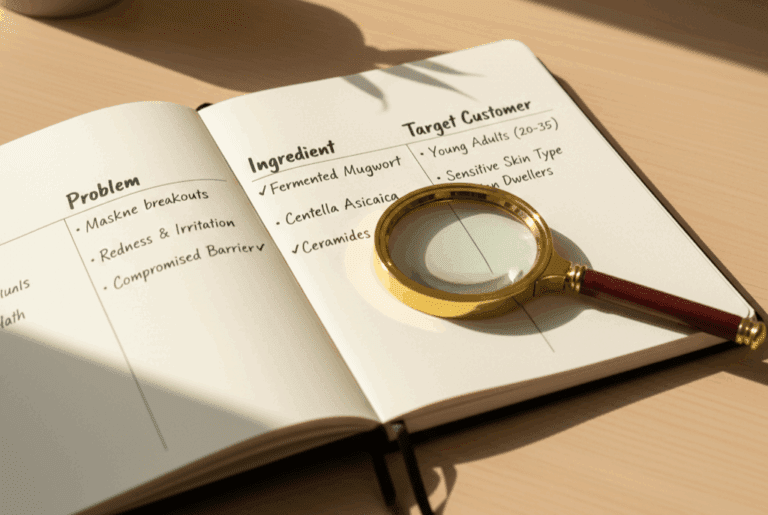
Using the 4 approaches (Problem-Based, Ingredient-Based, Philosophy-Based, Demographic-Based), write down 5 potential niche market candidates you’d like to target in the worksheet below. Don’t filter yet—just brainstorm.
Step 2: In-Depth Competitor Analysis
You have 5 ideas. Now, you must validate them.
- Choose the 2 most attractive niches from your brainstorm.
- Find 3 representative competitor brands in each market.
- Analyze: What is their core message, price point, main sales channels, and the key keywords from their customer reviews?
Tools for Analysis: You can use simple tracking methods like a shared document or project management tools like Asana or Notion to organize this research systematically.
Step 3: Define Your Evergreen Concept
Based on the market gap (Weakness of Competitors) and the Pain Point you discovered through your analysis, you are ready to define your evergreen product concept.
Your final concept must be summarized in one single, clear sentence.
- Example: “A low-irritation, soothing serum that uses Ganghwa mugwort fermented with probiotics, designed for skin barriers compromised by frequent mask-wearing.”
This single sentence is your brand’s entire focus and declaration of war against generalist brands.

Your Worksheet & To-Do List
This is your homework. Focus is salvation.
Niche Brainstorming (Worksheet Template)
| Approach | My Niche Market Idea | Target Customer | Core Value |
| Problem-Based | |||
| Ingredient-Based | |||
| Philosophy-Based | |||
| Demographic-Based | |||
| (Hybrid) |
Actionable To-Do List
- Complete the Niche Market Brainstorming worksheet (5 candidates).
- Complete the in-depth competitor analysis chart for the top 2 niches.
- Define my first evergreen product concept in one clear sentence.
Up next: We conclude the niche section by providing concrete Niche Market Examples—my actual filled-in worksheet to inspire your results!