The Shocking Truth: My 3 Strengths & 3 Fatal Weaknesses
Seeing real founder strengths and weaknesses examples on paper can make this entire journey feel more achievable.
In the last two posts, we’ve been through a lot. We completed the 12-point Founder Readiness Checklist and walked through the 3-step “Reality Check” to test your commitment.
I left you with a blank worksheet to analyze yourself. Today, as promised, I’m sharing my filled-in examples.
But more importantly, I’m sharing a final, crucial warning about the “preparation trap”—the single biggest thing that stops founders before they even begin.
Table of Contents
My Filled-In Worksheet: 3 Strengths
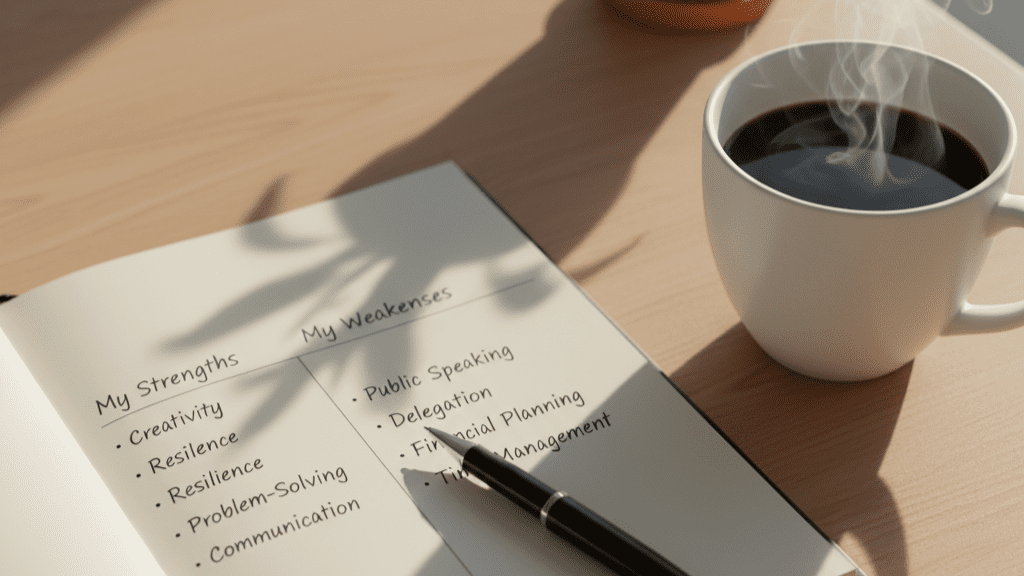
Here is what my list looked like before my first launch. These are my real founder strengths and weaknesses examples, starting with the good.
| My 3 Strengths |
| 1. Chemistry Background: Deep understanding of product ingredients and R&D processes, allowing for professional-level communication with manufacturers. |
| 2. MBA Degree: Trained in market analysis, business strategy, and how to see the “big picture” of a business model. |
| 3. High “Grit” & Entrepreneurial Spirit: A high tolerance for risk and a powerful “I’ll figure it out or do it myself” drive. |
Why this matters: On paper, this “Strength” profile looks almost perfect for a beauty founder. I had the Science (Chemistry), the Business (MBA), and the Grit (Spirit). I thought this was all I needed.
This list is a core part of my $250k failure story: strengths alone are never enough.

My Filled-In Worksheet: 3 Weaknesses (and a Plan)
This is the most important section of any founder strengths and weaknesses examples. This was my real list. And looking back, these are the exact red flags that led directly to my $250k failure.
| My 3 Weaknesses to Improve (and How to Improve Them) |
| 1. Weakness: Zero practical experience in finance/accounting (despite the MBA) |
| Improvement Plan: To hire a part-time CPA from Day 1 and set up weekly cash flow reviews. |
| 2. Weakness: No B2C/D2C experience; all background is B2B. (No industry network, no idea how to talk to customers). |
| Improvement Plan: To join D2C founder communities, take a Shopify course, and spend 10 hours/week in online forums (like Reddit) listening to customers. |
| 3. Weakness: I work spontaneously rather than planning systematically. |
| Improvement Plan: To use a project management tool (like Notion) for all R&D and launch timelines, and to have a financial advisor review my “spontaneous” decisions. |
Why this matters (This is the key):
- Weakness 1 + Weakness 3 (No finance skills + spontaneous) led to my 40%+ cost ratio and $250k deficit. I wasn’t tracking the numbers.
- Weakness 2 (No B2C skills) led to my hiring failures and slow growth. I didn’t know how to build a “fandom.”
This worksheet wasn’t just an exercise. It was a warning I didn’t take seriously enough. This is why I’m sharing my real founder strengths and weaknesses examples—so you can take yours seriously.
The Real “Preparation as Escape” Trap
I have given you a lot of hard questions in the last three posts.
- The 12-point checklist.
- The financial audit.
- The sacrifice test.
The purpose of this was not to scare you. It was to prepare you.
But you must not fall into the trap of never starting, stuck on the thought that “I’m not ready yet.” This is what I call “Preparation as Escape.” It’s when research and planning feel like work, but they’re really just a form of procrastination.
There is no such thing as a “perfectly” prepared founder.
All founders, including me, grow by jumping into uncertainty and solving problems as they come. A cold, hard diagnosis of yourself, like filling out these founder strengths and weaknesses examples, should never become an excuse for inaction.
Your Final Litmus Test: The Direction of Your Heart
So, I’ll ask you this.
Despite all these checklists, all these hard financial questions, and all the risks…
Is your heart still telling you, “I have to do this anyway”?
Despite acknowledging the 90% of the job that is a grind… despite seeing my $250k failure story… are you still convinced that the regret of not trying would be greater than the fear of failing?
If so, you have already passed the most important first gate.
Your heart is in the right place. You are not a dreamer; you are a builder.
Now is the time to trust that sound, stop just planning, and start building.